


If you searched for getsidehustles, you are probably looking for one of two things: a website offering ideas for earning extra income or information about whether the platform itself is worth your time. The distinction matters because “side hustle” websites can range from genuinely useful educational resources to thin content sites that simply recycle generic money-making advice.
This guide takes a closer look at what the site offers, what can be verified about it, where its content is useful, and what beginners should check before acting on any income opportunity they discover online.
Table of Contents
What Is GetSideHustles?
GetSideHustles is a website devoted to a blog with many articles about side hustles, earning an income online, free-lancing, businesses, etc. It defines itself as an website of interested parties in earning an extra amount of money.
Actually, content beyond just its name. It has business, technology, education, finance, fashion, travel, sports, and other things covered under different categories.
That creates an important distinction for readers:
GetSideHustles is better understood as a general-interest content platform with a side-hustle identity, rather than a dedicated marketplace where users directly receive paid gigs.
That means you should evaluate its articles as informational content—not automatically as verified job listings, income guarantees, or professional financial advice.
What Does the Website Cover?
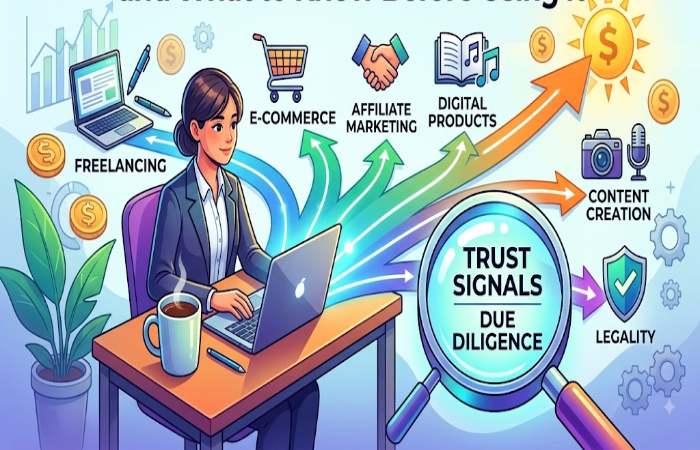
The site publishes articles across several areas connected directly or indirectly to earning opportunities.
Typical subjects include:
- Freelancing
- Online businesses
- Affiliate marketing
- Digital products
- E-commerce
- Content creation
- Marketing
- Business opportunities
- Technology
- Career and education topics
- Online learning
- General lifestyle subjects
One example of these articles mentions scalable online business models. These includes SaaS, digital products, dropshipping, affiliate marketing, content creation, agencies, memberships, apps, print-on-demand, and online marketplaces.
This breadth can be useful for beginners because it exposes them to different business models. However, it also means readers should not assume that every article represents a specialist analysis of earning potential.
Is GetSideHustles Legit?
There is an important difference between “I can access this website” and “every opportunity discussed on this website is legitimate.”
The website uses HTTPS (hypertext transport protocol secure) and claims a content author as its owner. An external website with domain information claims it was created January 9, 2026, although the content is copyrighted January 1, 2024.
However, the domain is relatively new, so there is limited long-term history from which to judge its reputation.
That does not prove the website is a scam. It simply means readers should avoid treating a relatively new site as an established authority without additional verification.
A sensible assessment is therefore:
GetSideHustles appears to be an active informational website, but its relatively short domain history means readers should independently verify specific income claims, companies, platforms, and opportunities before spending money or providing personal information.
That is a more useful conclusion than labeling a site “100% legitimate” or “a scam” without sufficient evidence.
How Current Is the Site?
The site’s publishing history provides another useful signal. In this recent round of content being indexed are articles that were published between March and April 2026, with coverage extending through enterprise search, fashion, and business-related articles, plus technology and more.
The business category also includes entries covering startup funding, e-commerce, online business models, marketing and business opportunities. This would indicate that this site has a current publishing history as opposed to the static dead domain. But the rate of publishing is not to be equated to editorial authority.
A website can publish frequently and still contain material that requires independent verification. For money-making content, source quality, transparency, realistic expectations, and evidence matter more than publishing volume.
What Can Beginners Learn From It?
The most useful role for a site like this is idea discovery.
Suppose you know you want additional income but don’t know which model fits you. Reading about different approaches can help narrow your options.
For example:
| Side-hustle model | What you generally need | Main advantage | Main limitation |
|---|---|---|---|
| Freelancing | A marketable skill | Can start with little capital | Requires client acquisition |
| Affiliate marketing | Content + audience | No inventory required | Traffic can take time |
| Digital products | Knowledge + product creation | Repeatable sales | Marketing is difficult |
| E-commerce | Product + fulfillment system | Large market potential | Costs and competition |
| Content creation | Consistency + audience | Multiple monetization options | Usually slow initially |
| Online services | Practical expertise | Faster path to first customer | Time is tied to revenue |
| Print-on-demand | Designs + storefront | No traditional inventory | Margins can be limited |
The key is not choosing the model with the biggest advertised income.
Which model can you realistically execute for the next 90 days?
That shift eliminates much of the hype surrounding online income.
The Biggest Mistake: Confusing Revenue With Profit
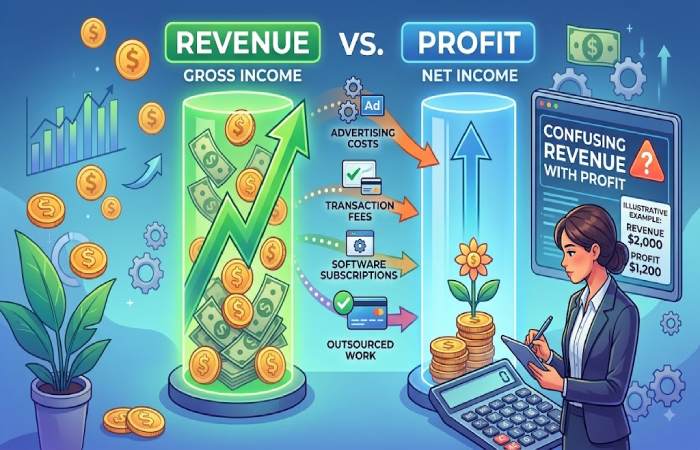 This is one of the most important concepts beginners should understand. Someone earning $2,000 from a side business has not necessarily made $2,000. Consider a simplified example:
| Item | Amount |
|---|---|
| Customer revenue | $2,000 |
| Advertising | -$300 |
| Software | -$100 |
| Payment fees | -$70 |
| Outsourced work | -$250 |
| Other expenses | -$80 |
| Estimated profit | $1,200 |
The numbers are illustrative, but the principle is real. Whenever you see an income claim, ask:
- Is this revenue or profit?
- How many hours were required?
- What expenses were involved?
- How long did it take to reach that level?
- Is the result typical or exceptional?
- Can the result be independently verified?
Without those questions, income screenshots and testimonials can create a misleading picture.
Why GetSideHustles Are Becoming More Relevant
The broader independent-work market provides evidence that alternative work arrangements are not simply an internet fad.
Upwork’s 2026 Future Workforce Index reported that the share of skilled U.S. knowledge workers freelancing increased from 28% to 38% in one year in its research sample. The study covered 2,400 U.S.-based skilled knowledge workers and combined survey results with marketplace data.
The 2025 edition had similarly found that 28% of skilled U.S. knowledge workers were working as freelancers or independent professionals. The important takeaway isn’t that everyone should become a freelancer.
It is that the modern labor market provides more ways to package and sell specialized skills than the traditional full-time-job model alone.
For a beginner, that could mean selling writing, design, editing, programming, marketing, research, tutoring, consulting, or another practical skill.
How to Evaluate a Side-Hustle Opportunity
Whether you discover an opportunity through getsidehustles or somewhere else, use a simple five-part test.
1. Identify Who Actually Pays You
Be specific.
Is your customer:
- An individual?
- A business?
- An advertising network?
- An affiliate program?
- A marketplace?
- A subscription customer?
If you cannot explain where the money comes from, you do not yet understand the business model.
2. Calculate the Startup Cost
Separate genuine necessities from optional expenses.
A legitimate side hustle might require software, equipment, advertising, education, or platform fees. That does not automatically make it bad.
The red flag is when someone says you must pay money to unlock your earnings or obtain a job. The FTC specifically warns that legitimate employers do not require applicants to pay to obtain employment.
3. Calculate Your Effective Hourly Rate
Suppose you make $300 but spend 30 hours doing the work.
Your gross hourly return is:
$300 ÷ 30 = $10 per hour
Then subtract relevant expenses.
This calculation can completely change which side hustles look attractive.
4. Check Whether the Model Can Scale
Some side hustles exchange time directly for money.
Others can eventually create leverage.
For example:
Service → repeatable process → productized service → digital product → audience
That progression is often more valuable than chasing a “passive income” idea immediately.
5. Look for Evidence Outside the Seller’s Website
Search for:
- Independent reviews
- Complaints
- Company registration information
- Terms and conditions
- Refund policies
- Real customer experiences
- Independent earnings evidence
The FTC recommends searching a company or opportunity together with terms such as “scam,” “review,” or “complaint” before proceeding.
Red Flags You Should Never Ignore
Online income content deserves extra scrutiny because scams often target people who are actively looking for ways to make money.
The FTC warns about several recurring patterns.
Guaranteed Income
Promises such as “guaranteed $500 every day” or “risk-free monthly income” should immediately trigger skepticism.
Real businesses have uncertainty.
Pay First, Earn Later
A legitimate course or software product can charge a normal price. That is different from an opportunity telling you that you must deposit money to access supposed earnings.
The FTC’s guidance is straightforward: never pay money to get paid or to get a job.
Unexpected Job Messages
Unexpected WhatsApp, Telegram, text, or social-media messages promising simple online work deserve particular caution.
The FTC has specifically warned about task scams in which victims are shown fake earnings and eventually pressured to deposit their own money, often using cryptocurrency.
Fake Checks
If someone sends you a check and asks you to deposit it and return part of the money, stop.
That is a well-known fake-check scam pattern.
Pressure to Act Immediately
“Limited spots.”
“Pay today.”
“Your account expires tonight.”
“Don’t tell anyone.”
These tactics are designed to reduce the time you have to investigate the opportunity.
A genuine opportunity should survive reasonable due diligence.
Is It Worth Reading?
For a beginner, getsidehustles can be useful as an idea-generation resource, particularly if you are unfamiliar with online business models.
Its articles introduce readers to subjects such as freelancing, digital products, affiliate marketing, e-commerce, content creation, and scalable online businesses.
But I would use the website in a specific way:
Use it to generate questions, not to make financial decisions for you.
That distinction is important.
Read an article, identify the business model, then investigate the actual platform, costs, competition, tax implications, customer demand, and potential risks independently.
A Better 30-Day Side-Hustle Strategy
Instead of researching 50 different opportunities, beginners can test one.
Week 1: Choose a Skill
List three things you can already do.
For example:
- Writing
- Video editing
- Graphic design
- Social media management
- Spreadsheet work
- Tutoring
- Translation
- Website development
Pick the one with the clearest customer.
Week 2: Validate Demand
Find businesses or individuals already paying for that service.
Do not ask, “Can I make money doing this?”
Ask:
“Who already pays for this, and what problem are they paying to solve?”
Week 3: Create a Small Offer
Avoid building a huge business immediately.
Create one simple offer:
“I will edit five short-form videos for $X.”
or
“I will create 10 social-media posts for $X.”
A defined deliverable is easier to sell and evaluate than a vague promise to “help with marketing.”
Week 4: Contact Potential Customers
Track:
| Metric | What to measure |
|---|---|
| Prospects contacted | Number |
| Responses | Number |
| Positive responses | Number |
| Calls or discussions | Number |
| Offers made | Number |
| Customers acquired | Number |
| Revenue | Total |
| Expenses | Total |
| Profit | Revenue − expenses |
This turns a side hustle from a vague dream into an experiment.
Final Verdict
GetSideHustles is an active content website focused on side hustles, online income, business, and related subjects. Its publishing history shows a broad collection of informational articles, while third-party domain information indicates that the domain itself is relatively new.
It may help inspire some side hustle ideas, but all financial information and opportunities described should be verified on the readers’ own accord and by using own judgment before anything valuable, sensitive or time consuming is shared. The bigger lesson is that no website will eliminate the hard work of building up a source of income.
