

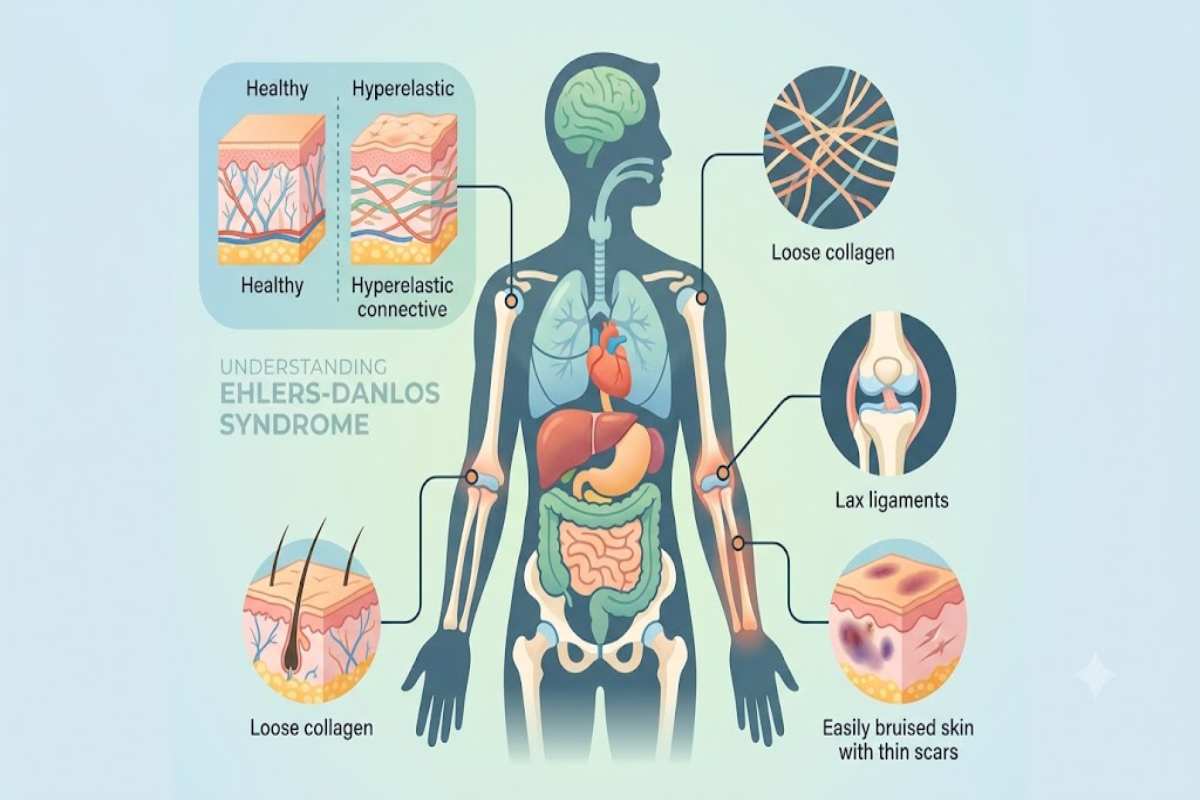
Ehlers-Danlos syndrome symptoms are a group of signs caused by inherited connective-tissue disorders, commonly involving unusually flexible or unstable joints, stretchy or fragile skin, easy bruising and chronic pain. Symptoms vary considerably depending on the EDS type, so having one or two features does not by itself confirm a diagnosis.
Ehlers-Danlos syndrome (EDS) refers to a group of inherited disorders affecting connective tissue, which supports the skin, joints, blood vessels and other parts of the body. Ehlers-Danlos syndrome symptoms can range from unusually flexible joints and frequent sprains to stretchy skin, easy bruising and persistent pain. The pattern depends on the specific type of EDS, and symptoms can vary substantially between individuals.
Table of Contents
What Is Ehlers-Danlos Syndrome?
EDS is not one single condition. The current classification recognizes 13 types, with hypermobile EDS (hEDS) being one of the most commonly encountered forms. Different types can affect connective tissue in different ways.
Most connective tissue disorders are inherited and are caused by a problem or abnormality in the structure and function of connective tissue. Because connective tissues occur in organs, you might have signs that affect your body in different ways.
Common Ehlers-Danlos Syndrome Symptoms
The most recognizable symptoms include:
| Symptom | What it may look like |
|---|---|
| Joint hypermobility | Joints move beyond the usual range |
| Joint instability | Joints may feel loose or give way |
| Dislocations or subluxations | A joint partially or completely moves out of position |
| Chronic pain | Persistent joint, muscle or soft-tissue pain |
| Stretchy skin | Skin extends more than expected |
| Easy bruising | Bruises develop after minor or sometimes unnoticed injury |
| Poor wound healing | Cuts may take longer to heal or produce unusual scars |
| Fatigue | Persistent tiredness, particularly in some people with hEDS |
| Flat feet | Reduced or flattened foot arches |
| Digestive symptoms | Functional bowel problems can occur in hEDS |
Hypermobile EDS is particularly associated with generalized joint hypermobility, joint instability, pain, soft or hyperextensible skin, easy bruising and recurrent soft-tissue injuries.
Joint and Muscle Symptoms
A significant one of the presenting features are commonly to the joints. Repeated sprains, clicking and popping of joints, hypermobility, dislocations or subluxations and discomfort after minimal activity.
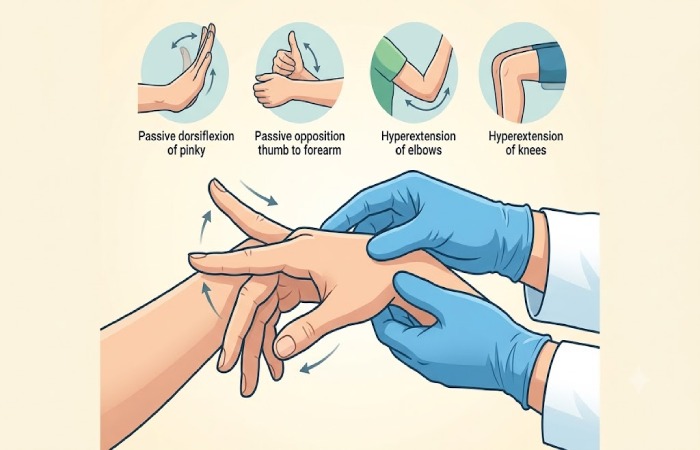
Chronic problems often can result from accumulated injuries with long term use of affected body parts. Just to be clear, being generally flexible isn’t evidence of EDS.
Skin-Related Symptoms
Some forms of EDS cause unusually soft or velvety skin that stretches more readily than expected. Classic EDS is particularly associated with skin hyperextensibility, fragile skin, easy bruising and characteristic atrophic scarring. Wounds may heal poorly and scars can become widened or thin.
Other Possible Symptoms
Some people, particularly those with hEDS, may also experience fatigue, migraine, functional gastrointestinal problems, autonomic symptoms, sleep problems or nerve-related symptoms. These features are not unique to EDS and should be assessed in their broader clinical context.
EDS Types and How Symptoms Differ
| EDS type | Features that may be prominent |
|---|---|
| Hypermobile EDS | Generalised hypermobility, instability, pain and soft/stretchy skin |
| Classical EDS | Stretchy and fragile skin, abnormal scarring and joint hypermobility |
| Vascular EDS | Arterial, intestinal or uterine fragility, thin translucent skin and easy bruising |
| Other rare types | May involve the eyes, spine, muscles, bones, teeth or other tissues |
Vascular EDS deserves particular attention because arterial, intestinal or uterine fragility can cause serious complications. It is distinct from the more common hypermobile presentation.
How Doctors Evaluate Possible EDS
There is no single symptom checklist that can diagnose every type of EDS.
A Practical Evaluation Workflow
Step 1: Medical history
A clinician reviews joint problems, pain, skin characteristics, bruising, injuries, family history and other symptoms.
Step 2: Physical examination
Joint mobility, skin characteristics, scarring and signs of instability may be assessed. Thus, a Beighton score can be used as part of evaluating generalised joint hypermobility.
Step 3: Consider alternative explanations
Joint hypermobility and chronic pain can occur in several other conditions. Doctors therefore need to distinguish EDS from other connective-tissue, musculoskeletal and rheumatological disorders.
Step 4: Genetic assessment where appropriate
Genetic testing can help establish certain EDS subtypes. However, there is currently no molecular genetic test that establishes hypermobile EDS itself.
When Should You See a Doctor?
See your doctor if you notice recurrent, unattributed joint dislocations; significant joint instability; extremely stretchy or loose skin; abnormal scarring; repeated, unexplained bruising or regular musculoskeletal pain. A particularly strong family history of a diagnosed EDS subtype may also be relevant.
Seek A&E care immediately if experiencing sudden severe chest, stomach, or back pain, fainting, any unusual serious bleeding, or other signs that indicate an underlying serious vascular and or internal organ problem. These symptoms alone are unlikely to be solely due to EDS, however the various rarer types may have vascular or internal organ fragility and need prompt investigation.
What to Expect After Diagnosis
There is no single treatment that applies to every person with EDS. Management is generally tailored to the individual’s symptoms and EDS type.
For those people who live with some joint instability or have had recent musculoskeletal injuries such as muscle strains or sprains, your Clinicians may advise a program of targeted physiotherapy, strength and conditioning, injury management, or pain solutions. Goals typically aim to make people more effective, minimize potential injuries and address their pain.
Expectations should therefore remain realistic. Symptoms can fluctuate, and progress may take time. A personalised plan is generally more useful than a generic exercise or treatment programme.
Ehlers-Danlos Syndrome vs General Joint Hypermobility
| Feature | General joint hypermobility | EDS |
|---|---|---|
| Flexible joints | Common | Common in many types |
| Chronic pain | May occur | Common in hEDS |
| Skin changes | Usually limited | May be prominent |
| Abnormal scarring | Not typical | Can occur in several types |
| Easy bruising | May occur for many reasons | Common in several EDS types |
| Genetic diagnosis | Not necessarily relevant | Relevant to some EDS types |
| Clinical assessment | Often straightforward | May require specialist assessment |
This distinction matters because flexibility alone is not enough to diagnose EDS. hEDS diagnosis relies on a broader clinical assessment and exclusion of alternative explanations.
Living With EDS: Practical Considerations
People with EDS may benefit from understanding their individual triggers and limitations. Keeping a record of recurrent injuries, joint instability, pain patterns and unusual skin or scarring features can make medical appointments more productive.
Exercise should be approached thoughtfully rather than avoided completely. Therefore, for someone with joint instability, a clinician or appropriately trained physiotherapist can help develop an activity programme that focuses on control, strength and safe movement.
Avoid self-diagnosing based solely on online flexibility tests. A person can be very flexible without having EDS, while some people with EDS may not appear dramatically flexible in every joint.
Frequently Asked Questions
What are the main Ehlers-Danlos syndrome symptoms?
Common Ehlers-Danlos syndrome symptoms include joint hypermobility, unstable joints, recurrent sprains or dislocations, chronic pain, stretchy or soft skin, easy bruising and unusual scarring. The exact combination varies by EDS type.
Can stretchy skin mean I have EDS?
Not necessarily. Stretchy skin can have several explanations. In EDS, clinicians consider skin characteristics alongside joint findings, scarring, family history and other clinical features.
Is EDS the same as being double-jointed?
No. Joint hypermobility can occur without EDS. EDS is a group of connective-tissue disorders with additional clinical features depending on the subtype.
Can EDS cause chronic pain?
Yes. Chronic pain is common in hypermobile EDS and may be related to joint instability, repeated soft-tissue injury or other musculoskeletal mechanisms.
Is there a cure for EDS?
There is currently no single cure for EDS. Management focuses on the specific EDS type and the person’s symptoms, with appropriate medical care, rehabilitation and injury prevention forming important parts of management.
Conclusion
Understanding Ehlers-Danlos syndrome symptoms starts with recognizing that EDS has several distinct forms and can affect people differently. Joint hypermobility, instability, chronic pain, stretchy skin, bruising and abnormal scarring are important clues, but none should be interpreted in isolation.
Although the symptoms seem obvious and no one would doubt its value if you consult you a medical professional in order to manage the symptoms when they do not recede. Thus, early diagnosis and recognition make it possible for individuals to manage their symptoms, physical activity and sport and injury prevention.
Medical disclaimer: This article is for general educational purposes and is not a substitute for diagnosis or treatment from a qualified healthcare professional. Anyone with concerning, severe or rapidly developing symptoms should seek appropriate medical care.
