

23 signs you grew up with Ehlers-Danlos syndrome may include unusually flexible joints, repeated sprains or dislocations, easy bruising, stretchy or fragile skin, chronic pain and unexplained fatigue. These experiences can occur for other reasons too, so recognizing several signs does not by itself confirm Ehlers-Danlos syndrome (EDS).
Growing up with Ehlers-Danlos syndrome can mean spending years thinking certain physical experiences are simply part of being “clumsy”, flexible or prone to injuries. EDS is actually a group of inherited connective-tissue disorders affecting structures such as skin, joints, blood vessels and other tissues. Symptoms vary considerably between EDS types.
The phrase 23 signs you grew up with Ehlers-Danlos syndrome is useful as a recognition guide, but it should not be treated as a diagnostic checklist. Several of the signs below can also occur in people who do not have EDS.
Table of Contents
What Is Ehlers-Danlos Syndrome?
Ehlers-Danlos syndromes are a group of heritable connective-tissue disorders. Many forms involve joint hypermobility, skin that is unusually stretchy or fragile, easy bruising or problems with tissue strength. There are multiple recognised EDS types, and their clinical features differ.
Hypermobile EDS (hEDS) is particularly associated with generalised joint hypermobility, although hypermobility alone does not mean someone has hEDS. Unlike several other EDS types, hEDS currently has no established genetic test and is diagnosed using clinical criteria.
23 Signs You Grew Up With Ehlers-Danlos Syndrome
1. You were unusually flexible
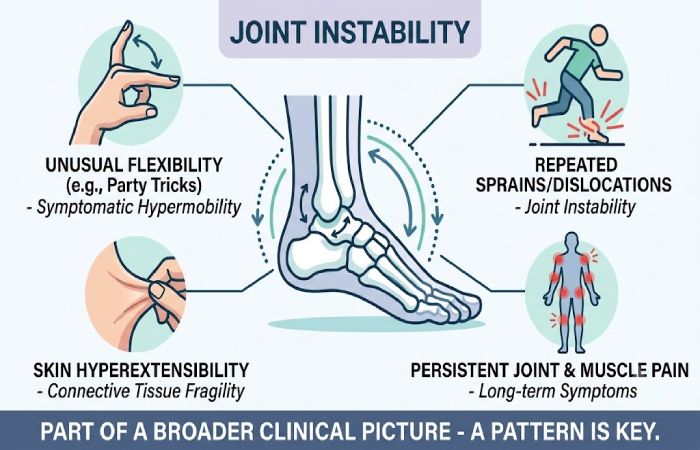
You may have been able to bend your fingers, elbows, knees or other joints further than friends could.
2. You could perform “party tricks”
Putting your thumb unusually close to your forearm or bending joints backwards may have seemed entertaining when you were young, but excessive joint movement can also indicate hypermobility.
3. You frequently sprained joints
Repeated ankle, wrist, knee or other sprains after relatively minor activity can be worth discussing with a clinician.
4. Joints sometimes partially slipped out
Subluxations involve partial displacement of a joint. Recurrent episodes may occur with joint instability in some people with EDS.
5. You experienced full dislocations
Repeated dislocations, particularly after ordinary movements or low-impact activity, are another possible clue.
6. “Growing pains” never seemed to disappear
Persistent or recurring musculoskeletal pain may have been attributed to normal childhood growth but continued into adolescence or adulthood.
7. Exercise caused disproportionate pain
Running, jumping or sports may have left you with significant joint or muscle discomfort compared with your peers.
8. You were frequently called clumsy
Poor coordination is not specific to EDS, but a history of frequent falls, sprains and unexplained injuries can form part of a broader clinical picture.
9. You bruised very easily
Some EDS types are associated with fragile tissues and easy bruising. Frequent unexplained bruises are worth mentioning to a doctor.
10. Your skin seemed unusually soft or stretchy
Stretchy or unusually soft skin occurs in several EDS types, although the degree varies between individuals.
11. Cuts took longer to heal
Some forms of EDS can involve fragile skin and abnormal wound healing. This is particularly relevant when combined with other connective-tissue features.
12. You developed unusual scars
Thin, widened or otherwise unusual scars can occur in certain EDS types. Scar characteristics are assessed alongside other clinical findings rather than in isolation.
13. You often had unexplained muscle aches
Muscle discomfort can accompany joint instability because muscles may work harder to stabilise mobile joints.
14. Your joints felt unstable
A feeling that a knee, ankle, shoulder or other joint was unreliable may have been more noticeable during sports or repetitive activity.
15. Handwriting was surprisingly tiring
Some people with symptomatic hypermobility report hand and finger discomfort during prolonged writing or gripping. However, this symptom alone is not evidence of EDS.
16. You had recurring headaches
Headaches are reported by some people with hypermobility-related conditions, but headaches have many possible causes and should not automatically be attributed to EDS.
17. You experienced persistent fatigue
Long-term fatigue can occur alongside chronic pain and other conditions associated with EDS or hypermobility. It is not specific to EDS.
18. You had unexplained digestive symptoms
Some people with EDS or hypermobility disorders report gastrointestinal symptoms. The relationship between EDS, associated conditions and many systemic symptoms remains an area of ongoing research.
19. Physical activity often required extra recovery time
If ordinary activity repeatedly left you sore or exhausted for longer than expected, that history may be useful when discussing your symptoms with a healthcare professional.
20. You were unusually flexible but not necessarily strong
Joint flexibility and physical strength are not the same thing. A person can have a large range of movement while still experiencing weakness or poor joint stability.
21. You repeatedly needed treatment for minor injuries
A childhood history involving frequent physiotherapy, supports, sprains or joint-related injuries may become more meaningful when viewed alongside other symptoms.
22. Similar joint or skin features run in your family
EDS is often inherited, although inheritance patterns vary by subtype and some genetic changes can arise for the first time in an individual.
23. Your childhood symptoms never seemed to fit one explanation
Perhaps the most important clue is the overall pattern: hypermobility combined with recurring injuries, pain, unusual skin characteristics or other persistent symptoms. A pattern is more informative than any single sign.
Childhood Clue vs Clinical Feature
| Childhood experience | Possible clinical interpretation | Does it confirm EDS? |
|---|---|---|
| “Double-jointed” | Joint hypermobility | No |
| Frequent sprains | Joint instability or injury susceptibility | No |
| Easy bruising | Tissue fragility | No |
| Stretchy skin | Skin hyperextensibility | No |
| Recurrent dislocations | Joint instability | No |
| Chronic pain | Musculoskeletal symptom | No |
| Family history | Possible inherited pattern | No |
| Unusual scars | Can occur in some EDS types | No |
This distinction matters because EDS diagnosis relies on the person’s history, physical examination and subtype-specific criteria. Genetic testing can confirm many EDS types, but there is currently no genetic test for hEDS.
Why EDS Can Be Missed During Childhood
Children naturally vary in flexibility, pain tolerance and coordination. A flexible child may simply be described as “bendy”, while recurring injuries can be attributed to sports or clumsiness.
The problem is that symptoms may appear across different parts of the body rather than as one obvious condition. Modern clinical assessment therefore considers medical history, family history and physical examination rather than relying on one symptom.
What To Do If These Signs Sound Familiar
A practical evaluation workflow
1: Write down your childhood and current symptoms.
2: Note recurring sprains, dislocations, pain, bruising and skin characteristics.
3: Record any relevant family history.
4: Discuss the pattern with a qualified doctor.
5: Ask whether assessment for hypermobility, EDS or another connective-tissue disorder is appropriate.
6: Follow specialist advice if additional examination, genetic testing or monitoring is recommended.
Do not attempt to diagnose yourself from an online list. A clinician may also consider other explanations for joint pain, hypermobility, fatigue or easy bruising.
EDS vs General Joint Hypermobility
| Feature | General hypermobility | EDS |
|---|---|---|
| Increased joint movement | Common | Common in several types |
| Symptoms required | Not necessarily | Depends on subtype |
| Skin involvement | Not necessarily | Present in some types |
| Genetic testing | Usually not relevant | Available for many types |
| Clinical assessment | May be sufficient | Essential |
| hEDS genetic test | No | No established test |
This is why being able to bend your joints unusually far is not enough to establish an EDS diagnosis. The Ehlers-Danlos Society distinguishes symptomatic hypermobility spectrum disorders from EDS using established diagnostic criteria.
Managing Expectations: What A Symptom List Can and Cannot Tell You
Recognising a pattern can be useful, particularly if symptoms have never been connected before. However, an online article cannot determine which EDS subtype a person has—or whether they have EDS at all.
There is also no single treatment that “cures” EDS. Management is generally focused on recognising the condition, monitoring relevant risks and treating individual manifestations. Prognosis varies according to the person’s symptoms and EDS type.
When Should You Speak With a Doctor?
Consider discussing your history with a healthcare professional if you have persistent joint instability, recurrent dislocations, unexplained widespread pain, unusual skin fragility or a strong family pattern of similar symptoms.
Seek prompt medical attention for severe or sudden symptoms rather than assuming they are caused by EDS. Certain rare EDS types can involve serious blood-vessel or organ complications, so an established diagnosis can be important when clinically appropriate.
Frequently Asked Questions
What are the 23 signs you grew up with Ehlers-Danlos syndrome?
The signs include unusual flexibility, recurrent sprains or dislocations, joint instability, chronic pain, easy bruising, stretchy or fragile skin, unusual scars, fatigue and other recurring symptoms. None of these signs alone proves that someone has EDS.
Can you have EDS without being extremely flexible?
Yes. EDS comprises multiple subtypes with different clinical features. Joint hypermobility is common in many forms, but the presentation varies considerably.
Can Ehlers-Danlos syndrome be diagnosed in adults?
Yes. EDS can be diagnosed at different ages. For hEDS, diagnosis is based on established clinical criteria rather than a genetic test. Other EDS types may be confirmed through genetic testing.
Is being double-jointed the same as EDS?
No. Some people are naturally hypermobile without having EDS. Clinicians consider the wider symptom pattern and appropriate diagnostic criteria.
Should I get tested for EDS?
If you have persistent symptoms or several features associated with a connective-tissue disorder, discussing them with a qualified healthcare professional is reasonable. The appropriate assessment depends on your individual history.
Conclusion
The 23 signs you grew up with Ehlers-Danlos syndrome can help put familiar childhood experiences into context, particularly when unusual flexibility, recurrent injuries, bruising, skin changes and persistent pain occurred together. However, these symptoms overlap with many other conditions and with normal variation. If the pattern is persistent or affecting daily life, a healthcare professional can help determine whether EDS, hypermobility spectrum disorder or another explanation deserves investigation.
