

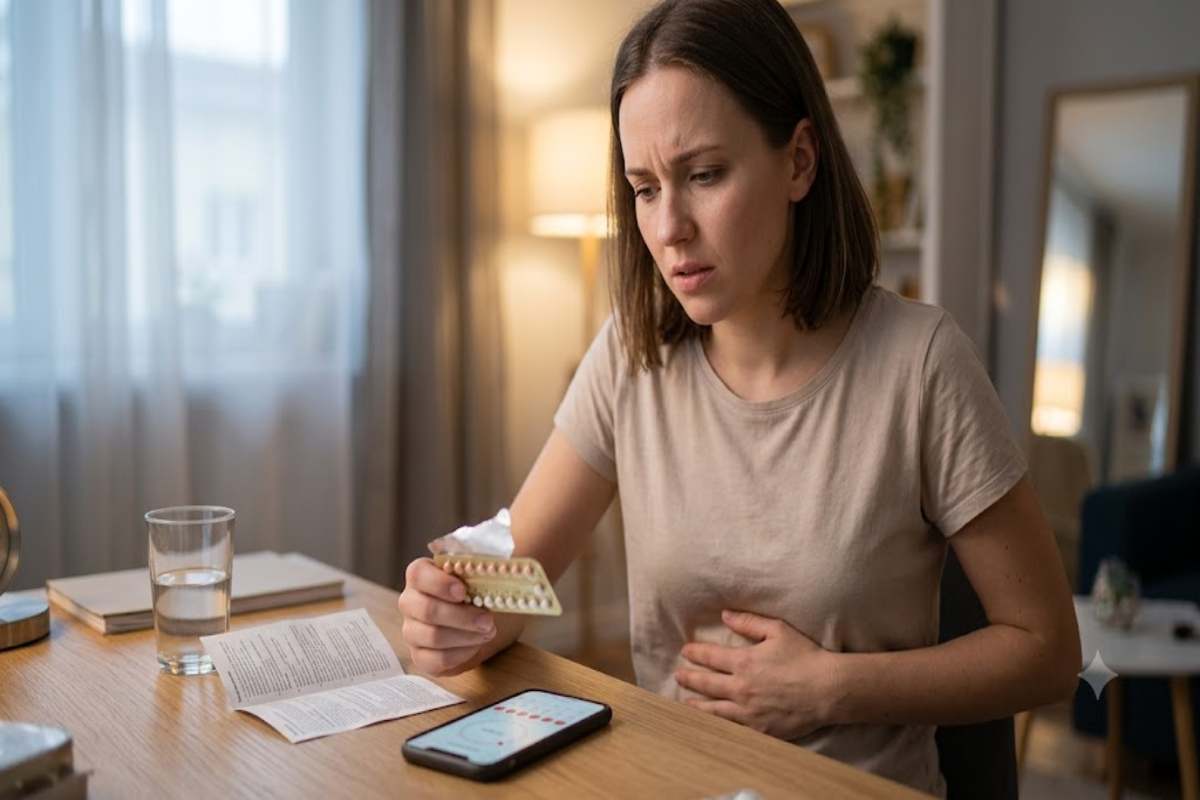
Why am I bleeding on the pill when I shouldn’t be? Bleeding while taking contraceptive pills is often called breakthrough bleeding or spotting and can happen even when the pill is being taken correctly. It is particularly common during the first few months, after missed pills or with some pill regimens, but persistent or heavy bleeding may need medical assessment.
If you are asking “why am I bleeding on the pill when I shouldn’t be?”, you are not alone. Unexpected spotting or bleeding can be unsettling, particularly when you are taking contraception specifically to make your periods more predictable or lighter.
Other potential side effect Bleeding between scheduled periods is a recognized side effect of hormonal contraception and may not indicate that your contraception is no longer functioning. Nevertheless, bleeding of this nature may indicate that you have missed pills, taken medication, are pregnant or are suffering from particular diseases-and the broader context may also be of some significance.
Table of Contents
What is breakthrough bleeding?
Breakthrough bleeding means bleeding or spotting that occurs outside the expected bleeding days of your contraceptive schedule. It may appear as a few pink or brown spots, light bleeding or, occasionally, bleeding that resembles a period.
With many combined contraceptive pills, bleeding normally occurs during the inactive or hormone-free pills. This is technically withdrawal bleeding rather than a natural menstrual period.
Break-through bleeding is especially frequent in the first months of use of the combined-pill and usually declines as the body begins to tolerate it better.
Why am I bleeding on the pill when I shouldn’t be?
Several explanations are possible:
| Possible reason | What it can mean |
|---|---|
| Starting the pill recently | Your body may still be adjusting to hormone changes |
| Missed or late pills | Hormone levels can fluctuate and trigger spotting |
| Continuous pill use | Skipping hormone-free intervals can make breakthrough bleeding more likely |
| Vomiting or severe diarrhoea | The pill may not be absorbed properly |
| Certain medicines or supplements | Some can interfere with contraceptive effectiveness |
| Emergency contraception | It can temporarily alter bleeding patterns |
| Infection | Some sexually transmitted infections can cause abnormal bleeding |
| Pregnancy | Pregnancy should be considered if pills were missed or contraception may have failed |
| Other gynaecological conditions | Fibroids, cervical problems and other conditions can cause irregular bleeding |
Breakthrough bleeding is particularly common during the first few months of combined-pill use and often becomes less frequent as the body adjusts.
A simple workflow for unexpected bleeding
Working Through Unexpected bleeding If you experience unexpectedly bleeding, follow these steps as opposed to fearing something is wrong with this.
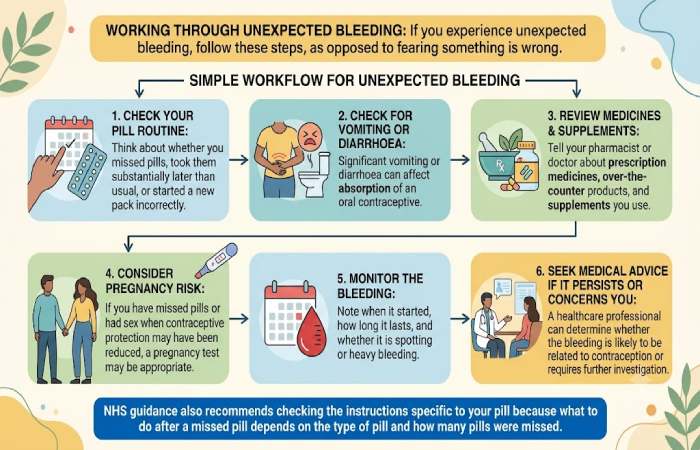
1. Check your pill routine
Think about whether you missed pills, took them substantially later than usual or started a new pack incorrectly.
2. Check for vomiting or diarrhoea
Significant vomiting or diarrhoea can affect absorption of an oral contraceptive.
3. Review medicines and supplements
Tell your pharmacist or doctor about prescription medicines, over-the-counter products and supplements you use.
4. Consider pregnancy risk
If you have missed pills or had sex when contraceptive protection may have been reduced, a pregnancy test may be appropriate.
5. Monitor the bleeding
Note when it started, how long it lasts and whether it is spotting or heavy bleeding.
6. Seek medical advice if it persists or concerns you
A healthcare professional can determine whether the bleeding is likely to be related to contraception or requires further investigation.
NHS guidance also recommends checking the instructions specific to your pill because what to do after a missed pill depends on the type of pill and how many pills were missed.
Can you still be pregnant if you are bleeding on the pill?
Bleeding does not reliably confirm or rule out pregnancy.
If you have taken your pills correctly, contraceptive protection is generally maintained according to the instructions for your particular pill. However, missed pills, absorption problems or interactions can reduce protection.
If pregnancy is possible, taking a pregnancy test can provide more useful information than trying to interpret the bleeding itself. Mayo Clinic also recommends considering a pregnancy test when expected bleeding does not occur after a potential contraceptive failure.
If you have a positive pregnancy test while taking the pill, speak with a healthcare professional for appropriate advice.
What can you do about breakthrough bleeding?
The most important step is not to stop your contraceptive pill simply because you have started spotting, unless a healthcare professional advises otherwise. Stopping unexpectedly can reduce contraceptive protection.
To reduce unpredictable bleeding If the bleeding doesn’t stop and the treatment is a problem, a sexual-health expert or your doctor may discuss alternative pill or contraception regimes.
Keeping a simple bleeding diary can also be useful. Record:
- The date bleeding starts and stops
- Whether it is spotting or heavier bleeding
- Any pain or other symptoms
- Missed or late pills
- New medicines or supplements
- Pregnancy-test results, if applicable
This gives your healthcare professional useful information if an assessment becomes necessary.
How long should breakthrough bleeding last?
There is no single duration that applies to everyone. Spotting is particularly common during the first few months after starting the pill and often improves as the body adjusts.
Expectations matter: one episode of light spotting does not necessarily indicate a problem, but repeated, persistent, worsening or heavy bleeding deserves attention.
If the bleeding remains troublesome after several months, speak with a doctor or pharmacist. Changing the pill or adjusting the contraceptive regimen may sometimes improve the bleeding pattern.
When should you see a doctor?
Contact a healthcare professional if:
- Bleeding is persistent or repeatedly returning
- Bleeding becomes heavy
- You develop significant pelvic or abdominal pain
- You have bleeding after sex
- You have symptoms suggesting an infection
- You think you could be pregnant
- You continue experiencing troublesome bleeding after the initial adjustment period
Heavy bleeding combined with significant abdominal or pelvic pain requires prompt medical assessment because pregnancy-related complications, including ectopic pregnancy, need to be excluded when pregnancy is possible.
Do not assume every episode of irregular bleeding is caused by the pill. Infections, fibroids, pregnancy-related problems and other gynaecological conditions can also cause abnormal bleeding.
Is bleeding on the pill a sign that it is not working?
Usually, no. Breakthrough bleeding is a known side effect of hormonal contraception and does not by itself prove that the pill has failed.
The bigger concern is whether something has reduced contraceptive protection—for example, missed pills or certain circumstances affecting absorption. That is why the timing of the bleeding and your pill-taking history are more useful than the bleeding alone.
Also remember that contraceptive pills do not protect against sexually transmitted infections. Condoms may still be appropriate when STI protection is needed.
Frequently Asked Questions
Why am I bleeding on the pill when I shouldn’t be?
Unexpected spotting is often breakthrough bleeding caused by hormonal changes. It can be particularly common when starting the pill, missing pills or using an extended or continuous regimen.
Can stress cause bleeding while taking the pill?
Stress can affect bleeding patterns in some people, but unexpected bleeding while using contraception should not automatically be attributed to stress. Consider missed pills, medicines, pregnancy and other possible causes as well.
Should I stop taking my pill if I start bleeding?
Generally, do not stop your contraceptive without checking the instructions for your specific pill or speaking with a healthcare professional. Stopping can reduce pregnancy protection.
Can you have a period while on the pill?
You can experience withdrawal bleeding during the hormone-free or inactive-pill days of some regimens. This is different from a natural menstrual period.
When is bleeding on the pill not normal?
Heavy, persistent or recurrent bleeding, especially when accompanied by pain or other symptoms, should be assessed by a healthcare professional rather than assumed to be a routine pill side effect.
Key Takeaways
- Breakthrough bleeding is common with hormonal contraceptive pills.
- It is particularly common during the first few months of use.
- Missed pills, continuous pill regimens and some medicines can contribute.
- Bleeding alone does not prove that contraception has failed.
- Consider pregnancy testing if contraceptive protection may have been reduced.
- Persistent, heavy or painful bleeding should be medically assessed.
- Follow the instructions for your specific pill rather than changing the schedule yourself.
Conclusion
So, why am I bleeding on the pill when I shouldn’t be? In many cases, the answer is breakthrough bleeding caused by normal hormonal adjustment, particularly when starting the pill or using it continuously. It can also occur after missed pills or changes that affect hormone levels.
A bit of unexpected bleeding isn’t necessarily cause for concern or indicate failure in contraception, but you really should be checked out if it is excessive or painful. And in the case where pregnancy is a possibility, get a pregnancy test and go and see your doctor. Don’t try and read between the bleeding lines for a clue there.