

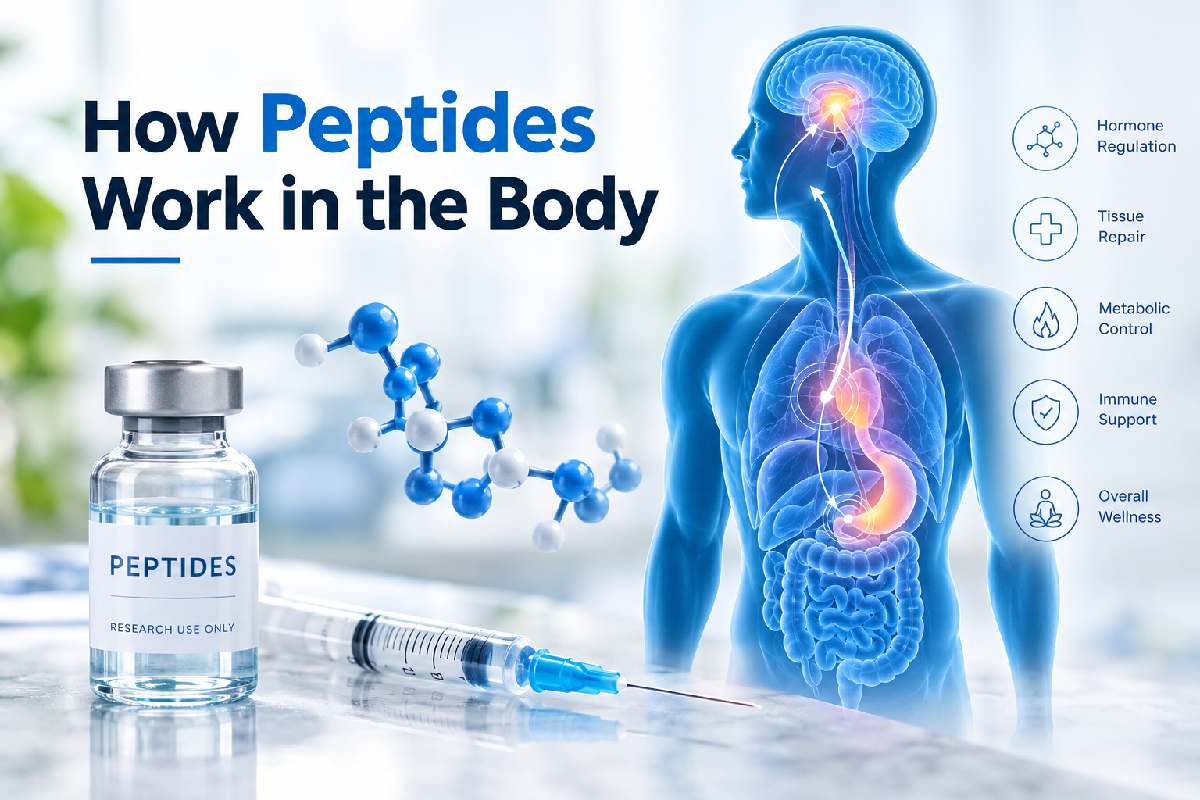
Peptides come up constantly in wellness and fitness conversations, explained with remarkable confidence by people who range from genuinely knowledgeable to completely making it up. The problem is they sound the same. The accurate explanations and the entirely wrong ones arrive in the same assured tone, which makes it hard to know what to actually trust.
Here’s what’s going on, without the jargon that makes this feel harder than it is.
Table of Contents
What a Peptide Actually Is
A peptide is a chain of amino acids. So is a protein. The difference is just length, which sounds minor until you understand what it changes. Peptides are shorter, conventionally under 50 amino acids, while proteins run longer. That size gap has real biological consequences. Smaller chains can cross certain barriers and interact with receptors that larger proteins simply can’t reach. They move through the digestive system differently.
They stick around in circulation for different lengths of time. Size is the variable that makes everything else about peptide research possible, which is why they get their own category instead of just being lumped in with proteins and left there.
How Peptides Signal
A lot of peptides studied in research aren’t doing the thing directly. They’re telling something else to do the thing. Growth hormone-releasing peptides are the most straightforward example: there’s no growth hormone in them. What they do is signal the pituitary gland to produce and release it. That distinction is worth sitting with for a second.
Working with the body’s own systems to trigger a response is a completely different mechanism from just supplying something the body then uses. It shows up in how effects develop over time, how the body adapts, and why the same compound can produce noticeably different results in different people.
Why Peptide Science Is Worth Following
Peptide science sits at an intersection of biochemistry and practical application that’s genuinely worth paying attention to. Understanding what different compounds actually do at the receptor level explains why some attract serious scientific interest while others, dressed in identical marketing language, don’t. It also explains why context matters so much. A peptide that activates one specific biological pathway stays in that lane. It doesn’t generalize.
Targeted mechanisms produce targeted effects, which is where most of the real value lives, and also why uniform results across all users isn’t something the biology supports.
Bioavailability and Delivery
Oral peptides face a fairly hostile environment. The digestive system is full of enzymes whose entire purpose is breaking peptide bonds, and they are extremely good at it. They do it to chicken breast. They do it to whey protein. They will absolutely do it to a research peptide without losing any sleep over it.
By the time a peptide survives the digestive system’s full demolition tour, it’s been broken down into individual amino acids. Nutritionally fine. Therapeutically useless. The thing that made it interesting is gone. That’s the whole problem. So research-grade peptides skip the gut entirely and go in subcutaneously, which is a more direct route and, more importantly, one that leaves the compound intact enough to actually do something.
It bypasses the whole problem. The compound skips digestion and reaches circulation intact, as the actual compound. An oral product claiming the same effects as a subcutaneous version deserves real scrutiny, because the biology of how that would work is not obvious.
Why the Research Keeps Building
The peptide field stays active because the signaling potential of these molecules is genuinely interesting from a biological perspective. The body uses peptides across an enormous range of functions. Immune regulation, tissue repair, hormone signaling, metabolic control. Understanding how synthetic versions interact with those existing systems is a legitimate scientific question with real clinical applications in development. It’s not a field propped up by hype alone.
Conclusion
Not every compound labeled ‘peptide’ is equally well-studied. The quality of the research behind different compounds varies enormously. The underlying science, however, is solid. The range of applications being researched continues to expand. A basic understanding of how these mechanisms work makes every subsequent decision in this space considerably more useful.