

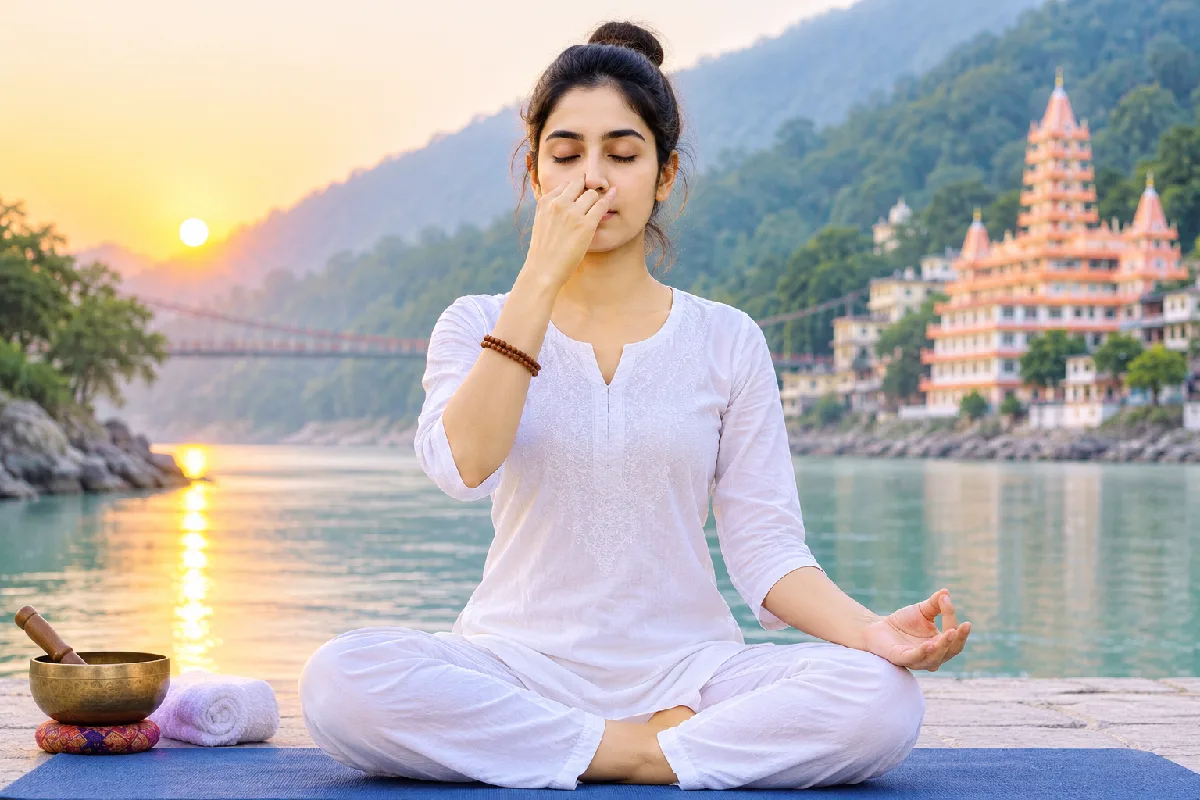
Pranayama is the regulation of breath described in the Hatha Yoga Pradipika, and it is the first class of every training day at our school in Rishikesh. It is also the part of the practice beginners get wrong most often, because the mistakes look like progress: breathing harder, holding longer, pushing further. The correct approach is slower, quieter and far more effective.
Key takeaways:
- Pranayama is the first class of the day, and it is taught before asana while the mind is quiet.
- The common mistakes are forcing retention, wrong posture, practising after meals and skipping the basics.
- The right approach is gradual: steady patterns first, retention only when the basics are easy.
Table of Contents
What pranayama actually is
The word breaks into two parts: prana, the breath and the life force it carries, and ayama, extension or regulation. Pranayama is not deep breathing for relaxation, although relaxation is one of its effects. It is a set of specific patterns of inhalation, exhalation and retention, each with its own ratio and its own purpose, taught in a sequence that builds over time.
The Hatha Yoga Pradipika places pranayama between asana and meditation, and that order matters. The body must be steady enough to sit, the breath must be regulated enough to hold the attention, and only then does meditation become possible. In our training courses the day is built on the same order: pranayama at 5:30 am, asana after it, philosophy and anatomy in the middle of the day, and meditation in the evening.
The practices taught in the foundation weeks are the same ones the texts describe: nadi shodhana (alternate-nostril breathing), kapalabhati (skull-shining breath), bhastrika (bellows breath), bhramari (humming breath) and ujjayi (the victorious breath used in asana). Each one is simple to describe and takes weeks to learn properly, because the learning is in the body, not in the description.
Mistake one: forcing breath retention
The most common mistake is also the most dangerous. Beginners read that retention, kumbhaka, is the heart of pranayama, and they try to hold the breath for as long as possible on the first day. The face goes red, the shoulders rise, the mind panics, and the breath comes back in a gasp.
Retention is introduced only after the basic patterns are steady, and it is introduced gradually. The teacher sets a ratio, such as inhaling for four counts, holding for four, and exhaling for eight, and the student practises that ratio until it is easy before the hold is lengthened. The Hatha Yoga Pradipika is clear on this point: the breath should be lengthened in measured steps, never forced, and the signs of correct practice are lightness and clarity, not strain.
The practical rule is simple. If the retention makes the face tense or the shoulders rise, the hold is too long. Shorten it until the breath stays smooth and the face stays soft. The retention will grow on its own over weeks of steady practice.
Mistake two: the wrong posture
Pranayama is a seated practice, and the seat matters. Beginners often sit in a chair with the back rounded, or cross-legged with the knees higher than the hips, or leaning against a wall. In each of these positions the breath cannot move freely, because the ribs are compressed or the diaphragm cannot descend.
The correct seat is simple: sit tall with the spine long, the shoulders dropped and the chest open. Cross-legged on a cushion works for most people; the cushion raises the hips so the knees can drop below them, and the spine lengthens naturally. A chair works too, if the feet are flat on the floor and the back is away from the chair back. What matters is that the spine is upright without effort, so the breath can move down into the belly and out again without obstruction.
The second part of posture is the hands. In nadi shodhana the right hand forms the mudra that closes the nostrils: thumb on the right nostril, ring finger on the left, index and middle fingers folded down. Beginners often press too hard, or hold the hand too high, and the arm tires within a minute. The touch is light, the elbow rests near the body, and the hand does almost nothing. If the arm aches, the hand is working too hard.
Mistake three: practising after meals
Pranayama on a full stomach is uncomfortable and unproductive. The diaphragm cannot descend when the stomach is full, the breath stays shallow, and the practice becomes an exercise in discomfort. The texts are direct about this: practice on an empty stomach, in the early morning, after emptying the bowels and washing.
In our training courses the first class starts at 5:30 am, before breakfast, for exactly this reason. For home practice the rule is the same: wait at least three hours after a full meal, or practise first thing in the morning before eating. A small cup of tea or warm water beforehand is fine; a full breakfast is not.
The related mistake is practising late at night. Some practices, especially kapalabhati and bhastrika, are heating and stimulating, and they will disturb sleep if done in the evening. The morning is the time for the full practice; the evening is the time for bhramari or slow diaphragmatic breathing only.
Mistake four: skipping the basics
Beginners often want to start with the advanced practices: long retentions, fast kapalabhati, the full bellows breath. The teachers at our school refuse this, and the refusal is the teaching. The basics are not a warm-up to be rushed through; they are the practice itself, and they take weeks to learn properly.
The sequence we teach in the foundation weeks is this:
- Week one: Diaphragmatic breathing only. Belly rises on the inhale, falls on the exhale, ten minutes a day. The aim is a smooth, even breath with no pauses and no effort.
- Week two: Nadi shodhana added, ten rounds, with the ratio 1:1, inhale and exhale equal. The aim is a breath that is smooth in both nostrils, with no forcing.
- Week three: Ujjayi added in asana, and bhramari in the evening. The aim is to hear the breath and to use it as an anchor for attention.
- Week four: Kapalabhati introduced, slowly, in short rounds. Retention introduced only if the basic patterns are steady and easy.
Students who follow this sequence arrive at the end of the month breathing differently: slower, deeper, and with a pause at the end of the exhale that was not there before. Students who skip ahead arrive at the end of the month with a strained breath and a headache.
Mistake five: counting wrong, or not counting at all
Pranayama is a counted practice. The ratio is the practice, and without counting there is no ratio. Beginners either do not count at all, letting the breath drift into its habitual pattern, or count too fast, so the breath becomes rushed and shallow.
The correct approach is to count slowly and evenly, using the same internal pace for every count. A simple method is to count in the rhythm of a slow heartbeat, or to use a mala, moving one bead per breath. The ratio to start with is 1:2: inhaling for four counts and exhaling for eight. When that is easy, the inhale can be lengthened, and only later is a hold added between them.
The counting also serves a second purpose: it holds the attention. The mind wanders during breath practice, and the count is what brings it back. Losing the count is not a failure; it is the signal to return to it, gently, without judgement. The Patanjali Yoga Sutras describe this same process in the context of meditation: the mind wanders, and the practice is the returning.
Mistake six: practising when ill or congested
Pranayama with a blocked nose, a cold or a fever is not practice; it is struggle. The texts list the conditions for practice, and illness is one of the reasons to stop. Kapalabhati and bhastrika are particularly unsuitable when the nose is blocked, because the force of the breath against a blocked passage causes pressure in the ears and the head.
The rule at our school is simple: if the nose is blocked, practise only slow diaphragmatic breathing, or skip the breath practice and rest. A day missed is nothing; a practice forced through illness sets the student back by days. The same applies to practising in extreme heat, in polluted air, or when exhausted. The practice needs a reasonably clear body and a reasonably quiet mind, and if either is missing, rest is the correct choice.
The correct approach: a simple daily practice
Here is the practice we give to beginners, to be done every morning before breakfast, for ten minutes:
- Sit tall on a cushion or a chair, spine long, shoulders dropped, eyes closed.
- Diaphragmatic breathing, two minutes: Hand on the belly, inhale for four counts, exhale for six. The belly rises and falls; the chest stays still.
- Nadi shodhana, five minutes: Ten rounds, ratio 1:1, inhale and exhale equal, smooth and unforced.
- Bhramari, three rounds: Hum on the exhale, low and steady, feeling the vibration in the chest and the head.
- Sit quietly, one minute: Let the breath return to its natural rhythm, and notice how it has changed.
Ten minutes, every day, at the same time, in the same place. After two weeks the breath is slower and the pauses at the end of the exhale are longer. After a month the practice has become a habit, and the habit is the foundation for everything that follows.
For students who want to learn the full practice, the 200 hour yoga teacher training in Rishikesh teaches pranayama as a month-long subject, with the same gradual sequence described here, under the guidance of teachers who have practised it for years. The course runs for one month and leads to the RYT 200 certification, and the breath practice is the thread that runs through the whole month, from the first 5:30 am class to the final assessment.
Frequently asked questions
How long should a beginner practise pranayama each day? Ten minutes is enough to start. The practice grows with the student, and twenty minutes a day is plenty for the first few months. Longer sessions come later, under a teacher’s guidance.
Is it normal to feel dizzy during breath practice? Light dizziness means the breath is being forced, usually by holding too long or breathing too fast. Stop, breathe normally for a minute, and restart with a shorter ratio. If dizziness keeps happening, ask a teacher before continuing.
Can I practise pranayama if I have asthma? Slow, gentle breathing is usually helpful, but fast practices like kapalabhati and bhastrika need a teacher’s guidance and a doctor’s clearance. Start with diaphragmatic breathing only, and build slowly.
Do I need to sit cross-legged? No. A chair works, as long as the spine is tall and the feet are flat on the floor. The seat should be comfortable enough to sit still for ten minutes without fidgeting.
When will I notice a difference? Most students notice calmer mornings within two weeks of daily practice. The deeper changes, a slower resting breath and longer pauses, take a few months of steady practice.
About the author
Team Aatm Yogashala, Rishikesh — https://aatmyogashala.com/