

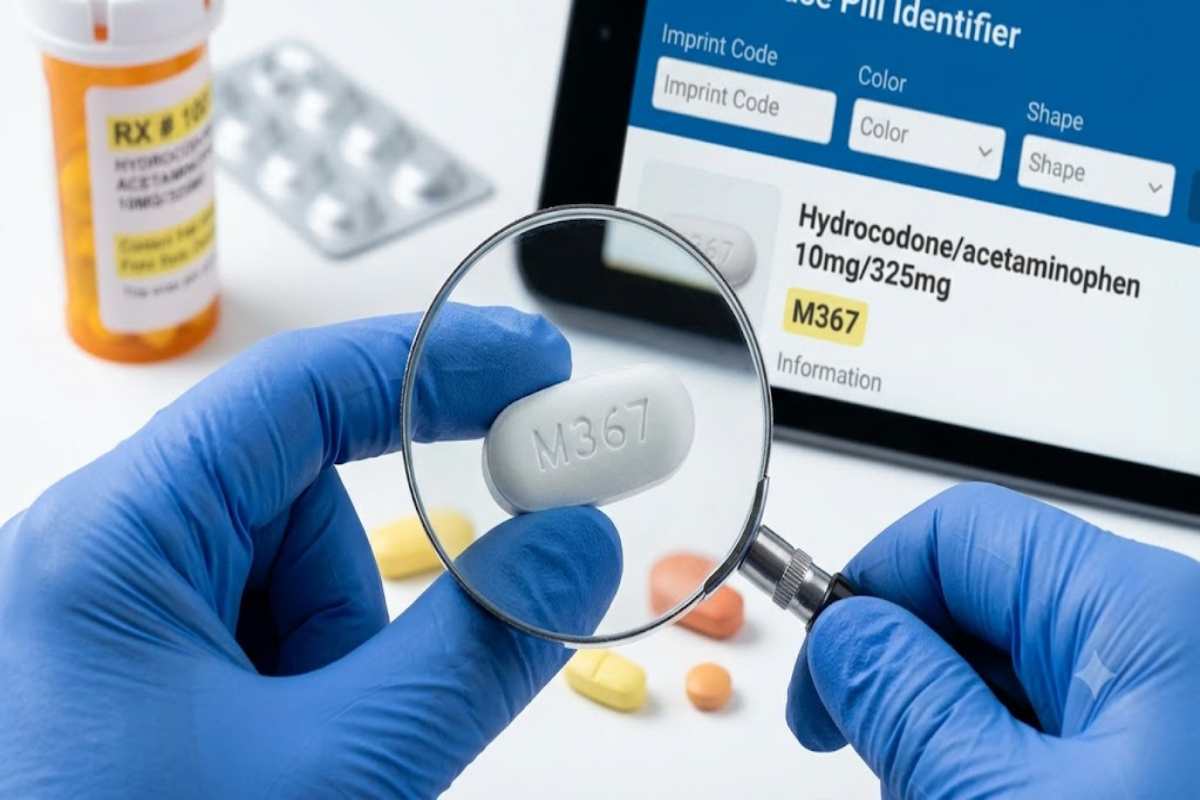
A hydrocodone acetaminophen pill identifier helps users compare a tablet’s imprint, colour, shape and strength with reliable medication information. Identification should be confirmed with a pharmacist or authorised medicine source rather than relying on appearance alone.
A hydrocodone acetaminophen pill identifier can be useful when a tablet looks unfamiliar, but identification requires more than matching its colour or shape. Hydrocodone is an opioid pain medicine, while acetaminophen is a non-opioid pain reliever; combination products are prescription medicines used for pain.
Because different manufacturers can produce tablets with different appearances, an imprint code is usually much more useful than colour alone. If there is any uncertainty, a pharmacist should verify the medicine before it is taken.
Table of Contents
What Is Hydrocodone Acetaminophen?
Hydrocodone/acetaminophen combines an opioid analgesic with acetaminophen. It may be prescribed for significant pain when an opioid is considered appropriate. Hydrocodone combination products can be habit-forming and can cause serious breathing problems, particularly during treatment initiation or after a dose increase.
The two ingredients also create different safety considerations. Hydrocodone can cause sedation and respiratory depression, while excessive acetaminophen can cause serious liver injury.
Common information shown on a prescription label
| Identifier | What it tells you |
|---|---|
| Active ingredients | Hydrocodone and acetaminophen |
| Strength | Amount of each ingredient per tablet |
| Imprint | Letters/numbers stamped on the tablet |
| Colour | Visual characteristic |
| Shape | Tablet design |
| Manufacturer | Company responsible for the product |
| NDC or product code | Regulatory/product identification information |
How a Hydrocodone Acetaminophen Pill Identifier Works
A practical identification process should involve several details rather than one visual feature.
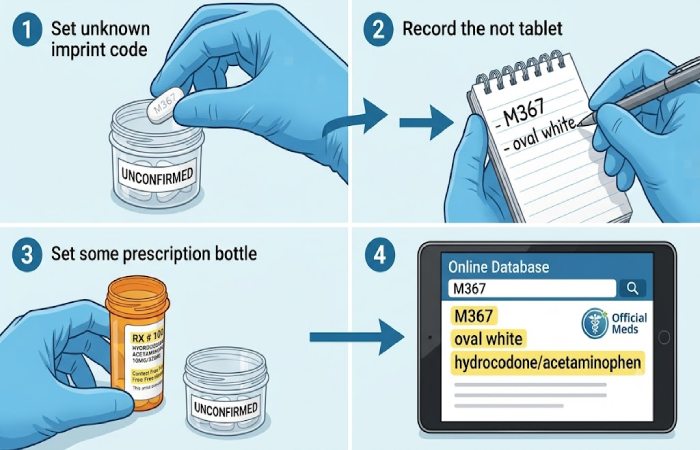
Pill identification workflow
1. Do not take an unknown tablet.
Set it aside until its identity has been confirmed.
2. Record the imprint.
Look at both sides and note every letter and number, including whether the tablet is scored.
3. Record physical characteristics.
Note the colour, shape and approximate size.
4. Check the packaging.
The prescription label, manufacturer information and strength can provide additional confirmation.
5. Compare with a reliable medicine database.
Use an authoritative source or a pharmacist rather than an unverified social-media post.
6. Confirm before use.
If the tablet still cannot be identified confidently, take it to a pharmacist.
Poison Control similarly recommends using the pill imprint when identifying an unfamiliar medicine and advises contacting the dispensing pharmacy when a prescription looks different from expected.
Why 5/325 Does Not Identify Every Pill
The designation 5/325 generally describes a strength containing 5 mg of hydrocodone and 325 mg of acetaminophen per tablet. However, strength alone does not uniquely identify a physical tablet.
For example, an FDA label for one historical Norco 5/325 product describes a white, orange-speckled, capsule-shaped tablet marked “WATSON” on one side and “913” on the other. This illustrates why the imprint, manufacturer and other characteristics matter together.
Important: tablet appearance and imprints can change between manufacturers and over time. Never assume that a pill is safe simply because it resembles a photograph online.
Pill Identification: Appearance vs Reliable Evidence
| Identification method | Usefulness | Limitation |
|---|---|---|
| Imprint code | High | Must match the correct product |
| Strength on packaging | High | Does not identify the physical tablet alone |
| Manufacturer | High | Manufacturer information may be missing |
| Colour | Moderate | Many medicines share colours |
| Shape | Moderate | Similar shapes are common |
| Online photograph | Low to moderate | Appearance can vary |
| Pharmacist confirmation | Very high | Provides professional verification |
Realistic expectations
A pill identifier is a screening and identification aid, not a guarantee of authenticity. A tablet can have an apparently correct imprint but still be counterfeit or obtained from an unreliable source. Poison Control warns that illicitly manufactured pills can carry professional-looking imprints that do not reflect their actual contents.
Safety Considerations
Hydrocodone can cause serious or potentially life-threatening breathing problems. Risk may increase when it is combined with alcohol, certain medicines or other substances that cause sedation.
Acetaminophen is another important consideration because taking multiple medicines containing acetaminophen can unintentionally increase total exposure.
Never change the prescribed dose simply because a pill looks smaller, larger or different from a previous prescription.
When urgent medical help may be needed
Severe drowsiness, inability to wake, slow or shallow breathing, loss of consciousness or other signs of overdose require immediate medical attention. Hydrocodone/acetaminophen overdose can involve both opioid-related toxicity and acetaminophen-related liver injury.
For an actual suspected overdose in India, contact local emergency medical services or a qualified medical professional immediately rather than relying on an online pill identifier.
Pros and Limitations of Pill Identifiers
| Advantages | Limitations |
|---|---|
| Can help narrow down an unfamiliar tablet | Cannot guarantee authenticity |
| Uses imprint and physical characteristics | Images can be misleading |
| Useful when packaging is unavailable | Manufacturer variations exist |
| Can support pharmacist discussions | Should not replace professional confirmation |
Who Should Use a Pill Identifier?
A pill identifier can be useful for someone who:
- Has received a tablet that looks different from a previous refill.
- Needs to record an imprint before speaking with a pharmacist.
- Wants to understand the identifying information printed on a medicine.
- Is checking whether a prescription tablet matches its labelled description.
It should not be used as permission to take an unknown or unprescribed opioid.
How to Check a Suspected Tablet Safely
A sensible approach is:
Tablet → imprint → packaging → reliable database → pharmacist confirmation → use only as prescribed
If the medicine came from a legitimate pharmacy and looks different from an earlier refill, the pharmacist can often explain whether the manufacturer or formulation has changed. Poison Control specifically recommends contacting the pharmacy when a prescription looks different.
Alternatives to Online Identification
For medication identification, alternatives include:
- A registered pharmacist — usually the most practical option.
- The dispensing pharmacy — particularly useful when the tablet came from a recent prescription.
- Official medicine information — useful for checking active ingredients and warnings.
- Poison-control services — appropriate when there has been a possible poisoning or ingestion.
Online databases can help narrow down possibilities, but they should not be treated as a substitute for professional confirmation.
Who Should Be Especially Careful?
People taking other medicines, alcohol or sedating substances should discuss hydrocodone with a doctor or pharmacist because combinations can increase serious adverse effects. Hydrocodone can also be habit-forming, so it should be taken exactly as prescribed.
Pregnancy, breastfeeding, respiratory conditions, liver problems and a history of substance misuse are additional reasons to discuss treatment with a healthcare professional before use.
Conclusion
A hydrocodone acetaminophen pill identifier can help narrow down what a tablet may be, particularly when its imprint and strength are known. However, online identification should remain a verification aid rather than a final safety check. Because hydrocodone is an opioid and acetaminophen can cause serious harm in excessive amounts, an unfamiliar tablet should be confirmed with a pharmacist or other qualified healthcare professional before use.
Frequently Asked Questions
What is a hydrocodone acetaminophen pill identifier?
A hydrocodone acetaminophen pill identifier is a tool or reference method that helps match a tablet using details such as its imprint, colour, shape and strength. It should be used for identification support, not as a substitute for pharmacist confirmation.
What does 5/325 mean?
It generally refers to a combination strength containing 5 mg of hydrocodone and 325 mg of acetaminophen per tablet. The exact product should still be confirmed using its label and imprint.
Can I identify a hydrocodone tablet by colour alone?
No. Colour alone is not sufficiently reliable because different medicines and manufacturers can use similar colours.
What if my prescription pill looks different this month?
Do not assume it is incorrect or take it solely because the name on the label is familiar. Check the imprint and contact the dispensing pharmacist for confirmation.
Can a pill identifier prove that a tablet is genuine?
No. An identifier can compare physical characteristics, but it cannot reliably establish that a tablet came from an authorised manufacturer. Counterfeit medicines can imitate legitimate markings.
