


Is coconut oil good for your hair? Yes, coconut oil can be useful for some hair types because research suggests it may reduce protein loss and help protect hair from grooming-related damage. However, it is not a proven treatment for hair loss, and applying it to the scalp may not suit everyone.
Coconut oil has been part of hair-care routines for generations, particularly in India and other tropical regions. But is coconut oil good for your hair, or is its popularity mainly based on tradition? Research suggests there is a reasonable scientific basis for using coconut oil on the hair shaft, particularly to reduce protein loss and some forms of damage. However, the results depend on your hair type, how much oil you use and where you apply it.
The thing of most interest is that it could coat the hair we already have from being broken down and damaging itself.. It doesn’t and can not be grown, nor hair loss stopped.
Table of Contents
What Does Coconut Oil Do for Hair?
Because it contains large proportions of fatty acids (the primary being lauric acid), coconut oil has chemical properties that enables it to combine with hair fibre – to a greater degree than other oils, it can even penetrate within the hair shaft somewhat.
In fact, one popular coconut oil study indexed by PubMed concluded that of the 3 oils they tested coconut oil was the only one that reduced the amount of protein loss from both the damaged and undamaged hair when shampooing hair before, and shampooing hair after washing. Because we wash, brush, heat, and chemical-style our hair often, its bonds begin to break down.
Potential benefits
| Potential benefit | What the evidence suggests | Realistic expectation |
|---|---|---|
| Reduced protein loss | Coconut oil may reduce protein loss during grooming | Less damage over time |
| Smoother appearance | Oil can coat the hair and reduce roughness | Hair may feel softer and look shinier |
| Less dryness | Oils can help reduce moisture loss from the fibre | Useful mainly for dry or coarse hair |
| Reduced breakage risk | Protecting the hair fibre may reduce some forms of mechanical damage | It cannot prevent every type of breakage |
| Split-end appearance | Oil can temporarily smooth damaged ends | It does not permanently repair split ends |
Is Coconut Oil Good for Your Hair Type?
Coconut oil is not equally useful for everyone. Hair texture, thickness, porosity and existing damage can affect the result.
Dry, coarse or curly hair: These hair types may tolerate a small amount of oil well, especially on the lengths and ends.
Fine or straight hair: Coconut oil can easily make fine hair look greasy or flat. A very small amount may be more appropriate.
Chemically treated hair: Coloured, bleached or chemically processed hair may benefit from a protective pre-wash treatment, although coconut oil does not reverse chemical damage.
Oily or dandruff-prone scalp: Applying oil directly to the scalp may be unhelpful. Cleveland Clinic notes that oiling the scalp may worsen problems such as seborrhoeic dermatitis in susceptible people.
How to Use Coconut Oil on Your Hair
The simplest approach is to treat coconut oil as a pre-wash hair treatment, rather than leaving a large quantity on the scalp.
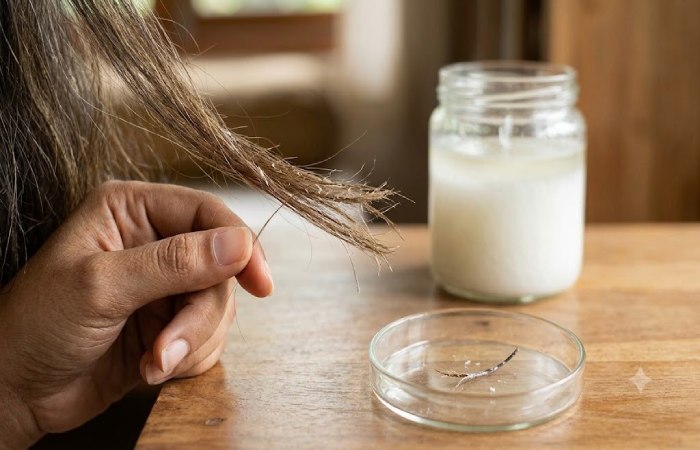
A simple coconut oil hair-care workflow
- Start with dry hair.
Detangle gently before applying anything. - Use a small amount.
Warm a little coconut oil between your palms rather than soaking the hair. - Concentrate on the lengths and ends.
These areas are often older and more exposed to styling damage. - Leave it for a limited period.
Around 20–60 minutes is a practical starting point for many people. - Wash thoroughly.
Use shampoo on the scalp and allow the lather to clean the lengths as it rinses through. - Condition afterwards if needed.
Conditioner can help with detangling and manageability.
Cleveland Clinic similarly recommends using a small amount and focusing application from the middle of the hair towards the ends rather than automatically covering the scalp.
How Often Should You Use Coconut Oil?
There is no universal schedule. Once a week is a reasonable starting point for someone with dry or coarse hair, while someone with fine or oily hair may need it less frequently.
The goal is not to make the hair permanently oily. If your hair feels heavy, sticky or difficult to wash after treatment, reduce the amount or frequency.
The American Academy of Dermatology recommends choosing hair-care practices according to your hair type and avoiding unnecessary manipulation that can cause breakage.
Coconut Oil vs Other Hair Oils
Coconut oil is not automatically the best oil for every person.
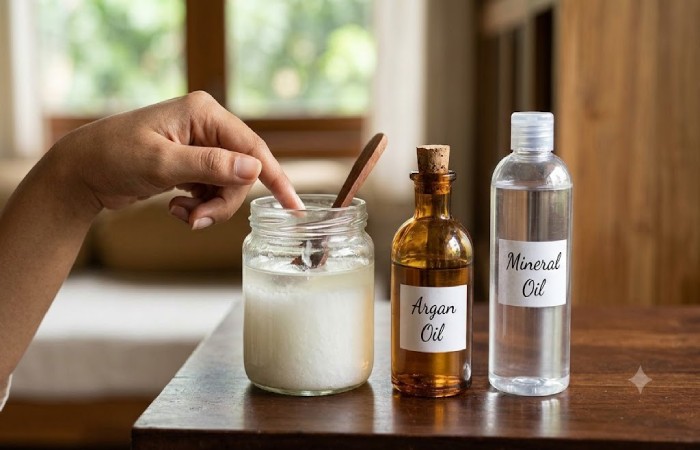
| Factor | Coconut oil | Argan oil | Mineral oil |
|---|---|---|---|
| Hair penetration | Evidence suggests some penetration | Primarily coats the fibre | Limited penetration |
| Protein-loss protection | Good evidence compared with tested oils | Evidence varies | Less effective in the cited study |
| Best suited to | Dry, coarse or damaged hair | Shine and lightweight conditioning | Primarily surface conditioning |
| Heavy feeling | Can be heavy | Usually lighter | Can feel coating |
| Scalp application | Not suitable for everyone | Depends on individual scalp | Usually better viewed as a hair-fibre product |
The comparison comes from research examining coconut, sunflower and mineral oils; it should not be interpreted as proof that coconut oil is superior to every hair oil available.
Coconut Oil and Hair Growth: What Should You Expect?
This is where expectations matter most. It may help reduce damage and breakage, which can make hair appear healthier and help you retain existing length. That is different from stimulating the biological growth of new hair.
There is not strong clinical evidence that simply applying coconut oil to the scalp causes new hair to grow in people with pattern hair loss, alopecia or other medical causes of thinning.
You can’t use hair oil to substitute for a diagnosis in cases of shedding, expanding parting, bald spots or extreme thinning Hair loss, thinning and other such problems can be diagnosed by dermatologist and a relevant treatment suggested for you.
Possible Downsides of Coconut Oil
Natural does not automatically mean suitable for everyone.
Potential problems include:
- Hair becoming greasy or weighed down.
- Difficulty removing excess oil.
- Product build-up when used too frequently.
- Scalp irritation in sensitive individuals.
- Possible worsening of scalp problems in people prone to dandruff or seborrhoeic dermatitis.
- Breakouts around the hairline if oily hair products come into contact with acne-prone skin.
The American Academy of Dermatology explains that oily hair products can contribute to clogged pores and breakouts around the hairline and forehead.
If you notice itching, redness, a rise in flaking, or ongoing pain following your use of coconut oil, discontinue use and consider consulting with a dermatologist.
Pros and Cons at a Glance
| Pros | Limitations |
|---|---|
| May reduce protein loss | Does not cure hair loss |
| Can improve the feel of dry hair | May weigh down fine hair |
| Useful as a pre-wash treatment | Can create build-up |
| Widely available in India | May not suit dandruff-prone scalps |
| May help protect damaged hair | Does not permanently repair split ends |
Who May Benefit Most?
Coconut oil may be worth trying if you have:
- Dry or coarse hair.
- Curly or textured hair that needs extra conditioning.
- Hair exposed to frequent washing or heat styling.
- Dry-looking lengths and ends.
- Hair that feels rough or prone to breakage.
You may want to skip or limit it if you have very fine hair, an oily scalp or a history of scalp irritation.
Tips for Choosing Coconut Oil for Hair
If you want to experiment with coconut oil, keep the routine simple.
Choose a product intended for cosmetic or hair use and avoid mixing several new ingredients at once. This makes it easier to identify what works for your hair.
You also do not necessarily need an expensive specialist hair oil. The evidence relates to coconut oil itself, but individual commercial products can contain fragrances, herbs and other ingredients that change how the product behaves.
Conclusion: Is Coconut Oil Good for Your Hair?
So, is coconut oil good for your hair? For many people, yes — particularly as a pre-wash treatment for dry, coarse or damaged hair. Research indicates that coconut oil can reduce protein loss from hair and may help limit certain types of grooming-related damage.
Overall, though, it should be considered a hair protection and conditioning choice rather than a growth promoting magical potion. Start by using just a little, concentrate on ends and lengths, and note how your scalp and hair take to it. Unexplainable and ongoing hair loss warrants seeking professional evaluation rather than solely resorting to coconut oil.